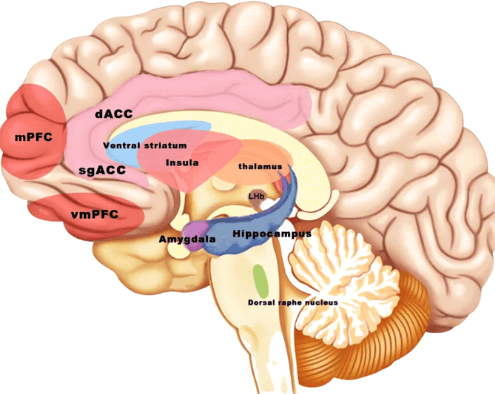
Transcutaneous vagus nerve stimulation (tVNS) activates key brain regions associated with cognitive functions, and these activations contribute to potential therapeutic effects in Alzheimer’s disease (AD).
Here are the key brain regions activated by tVNS and their implications for AD treatment:
Locus Coeruleus (LC):
-
-
Activation: tVNS can stimulate the LC, a brain region involved in regulating attention, arousal, and stress responses.
-
Contribution to AD: The LC-norepinephrine pathway is implicated in AD pathology, with LC degeneration contributing to cognitive decline. By activating the LC, tVNS may enhance attention and cognitive function in AD patients .
Nucleus Tractus Solitarius (NTS):
-
-
Activation: tVNS influences the NTS, a key nucleus in the brainstem that receives vagal afferent signals and plays a role in autonomic regulation.
-
Contribution to AD: The NTS is involved in modulating autonomic functions and gut-brain communication. By activating the NTS, tVNS may impact the brain-gut-microbiota axis, potentially influencing cognitive dysfunction in AD .
Hippocampus:
-
-
Activation: tVNS can modulate activity in the hippocampus, a critical brain region for memory formation and learning.
-
Contribution to AD: Hippocampal atrophy and dysfunction are hallmark features of AD. By enhancing hippocampal activity, tVNS may improve memory and cognitive functions in AD patients .
Prefrontal Cortex (PFC):
-
-
Activation: tVNS may also activate the prefrontal cortex, a region involved in executive functions, decision-making, and cognitive control.
-
Contribution to AD: Dysfunction in the PFC is associated with cognitive impairments in AD. By stimulating the PFC, tVNS may enhance executive functions and cognitive control in AD patients .
Basal Ganglia:
-
-
Activation: tVNS can modulate activity in the basal ganglia, a group of subcortical nuclei involved in motor control and cognitive functions.
-
Contribution to AD: Basal ganglia dysfunction is linked to cognitive deficits in AD. By influencing basal ganglia activity, tVNS may improve motor and cognitive functions in AD patients .
Thalamus:
-
-
Activation: tVNS may affect the thalamus, a relay center for sensory and motor signals in the brain.
-
Contribution to AD: Thalamic dysfunction can impact sensory processing and cognitive functions. By modulating thalamic activity, tVNS may enhance sensory integration and cognitive processing in AD patients.
Overall, the activation of these key brain regions by tVNS plays a crucial role in modulating cognitive functions relevant to AD. By targeting these regions, tVNS may offer therapeutic benefits for AD patients by improving memory, attention, executive functions, and overall cognitive performance.
References:
Frontiers in Aging Neuroscience. (2024, February 27). Transcutaneous vagus nerve stimulation: A new strategy for Alzheimer’s disease intervention through the brain-gut-microbiota axis? In Alzheimer’s Disease and Related Dementias (Vol. 16, 2024). https://doi.org/10.3389/fnagi.2024.1334887