

Cart 0
Updating cart…
No products in the cart.
Continue shopping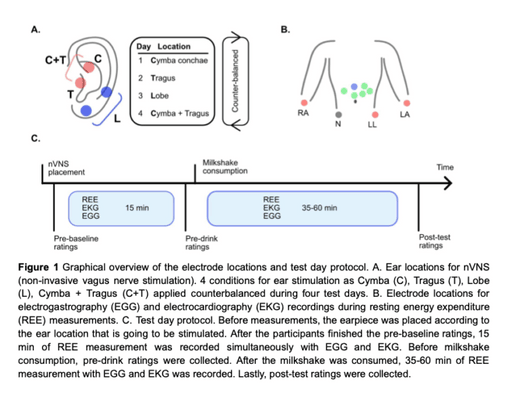
Vagus nerve signals from the gut to brain carry information about nutrients and drive food reward. Such signals are disrupted by consuming large amounts of high-calorie foods, necessitating greater food intake to elicit a similar neural response. Non‐invasive vagus nerve stimulation (nVNS) via a branch innervating the ear is a candidate treatment for obesity in humans. There is disagreement on the optimal location of nVNS in the ear for experimental and clinical studies. There are also no studies comparing nVNS in hungry and full states. We aimed to compare ear position(s) for nVNS and explore the effects of nVNS during hungry and full states on proxies for autonomic outflow (heart-rate variability) and efferent metabolism (gastric frequency and resting energy expenditure).
In a within-subject design, 14 participants (10 women, on average 29.4 +/- 6.7 years old) received nVNS in four different locations (cymba conchae, tragus, earlobe, or tragus AND cymba conchae) on separate days. In each session, participants were asked to consume a palatable chocolate flavored milk. With electrography on the abdomen and indirect calorimetry in a canopy, we measured electro-cardiogram, electro-gastrogram and resting energy expenditure for 15 minutes before and at least 35 minutes after consumption of the palatable drink. We also collected ratings of the palatable drink and internal and other states.
Pre-drink consumption (in a hungry state) we observed no differences in the effect of location of acute nVNS on resting energy expenditure and gastric frequency. However, nVNS in cymba conchae decreases heart-rate variability and ratings of how much participants want to consume the drink. After drink consumption and with continued nVNS, gastric frequency is unchanged, and resting energy expenditure increases regardless of stimulation location. Heart-rate variability decreases in all locations, except cymba conchae. We also observe a trend for an increase in gastric frequency in late post-drink consumption time-points in cymba conchae. These results suggest that nVNS in the cymba conchae in a hungry state has a similar acute effect on vagal tone as food consumption: to decrease heart rate variability. This effect then negates the usual postprandial effects of a decrease in heart rate variability as seen in the other nVNS locations. This suggests that nVNS in cymba conchae may act primarily on vagal afferent autonomic (and only modestly on metabolic output) in a similar way as food consumption does.
Authors: Zeynep Altınkaya, Lina Öztürk, İlkim Büyükgüdük, Hüseyin Yanık, Dilan Deniz Yılmaz, Berçem Yar, Evren Değirmenci, Uğur Dal, Maria Geraldine Veldhuizen


